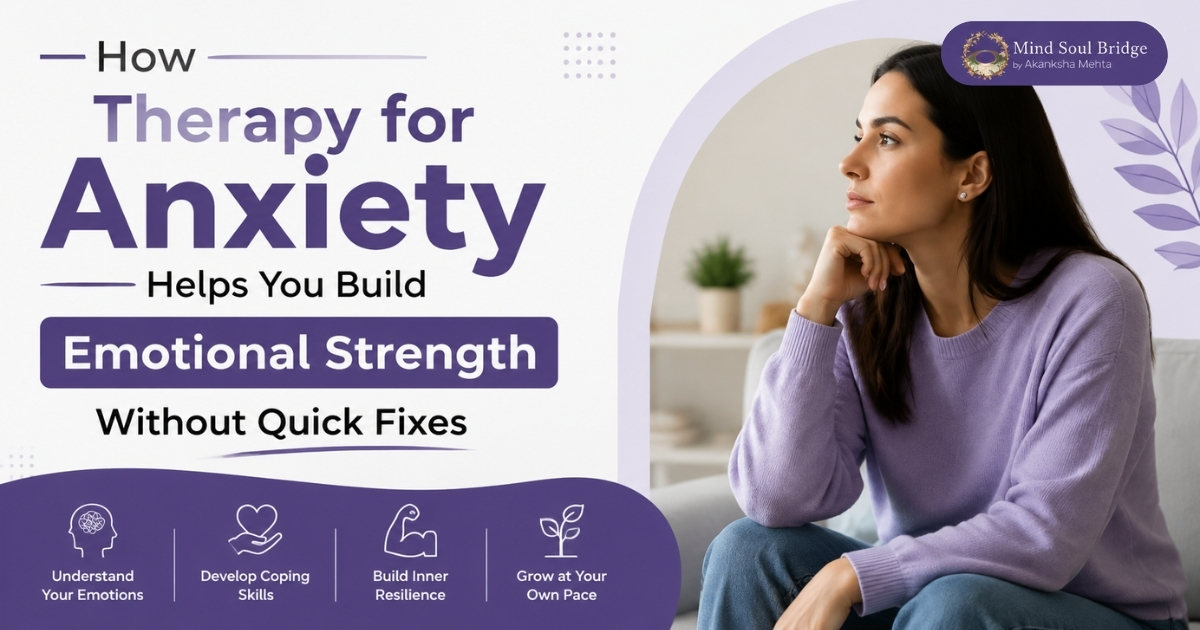




We’re surrounded by promises of instant relief these days. A five-minute video claims it’ll stop the overthinking. A quote on your feed tells you to “just stay positive.” It might help for an hour, maybe less. Then the anxious thoughts creep back in, same as before.
That’s because anxiety isn’t something you switch off.
Real healing takes time , understanding yourself, learning different ways to sit with difficult emotions, building resilience bit by bit. That’s what therapy for anxiety is actually there to do. It’s not about fixing something broken in you. It’s about helping you feel steadier, calmer, and more capable of handling whatever life throws at you.
Anxiety has a way of convincing you every hard feeling needs to vanish right now. Therapy works differently.
Rather than pushing uncomfortable emotions away, you learn to sit with them without letting them run your life. Bit by bit, things that once felt unmanageable start to feel ordinary.
Over time, this kind of work helps you:
None of this is a quick fix. These are skills that stay with you well after the session ends.
Sometimes advice isn’t what you need. Sometimes you just need someone who’ll actually listen.
That’s the heart of Individual counselling.
It’s a safe space , no judgement, no rush , to talk about your worries, your fears, your relationships, whatever’s weighing on you. As things start making more sense, you begin to understand why you react the way you do in the first place.
A lot of people find that anxiety itself isn’t really the issue. Underneath it is usually stress, something from the past, self-doubt, or patterns built up over years. Therapy helps you work through those layers, at whatever pace suits you.
Anxiety tends to send your mind straight to worst-case scenarios.
Mindfulness therapy works on pulling your attention back to the here and now.
That’s not about shutting your thoughts out. It’s about noticing them without handing them the wheel.
Things like mindful breathing, grounding exercises, and body awareness sound simple, but they add up over time. They settle your nervous system and open up a little gap between what you think and how you react.
That gap, small as it is, becomes your strength.
Sometimes all it takes is a change of scenery to actually slow down.
Wellness therapy retreats and pairs proper therapeutic support with time away from your usual routine. They’re not holidays, and they’re not a cure-all. What they offer is dedicated space to reflect, process, and reconnect with yourself somewhere supportive.
If you’re feeling burnt out or constantly on edge, stepping outside your everyday environment can give you the room to actually process what you’re feeling.
Here’s something that surprises most people: progress in therapy rarely feels big.
You pause before reacting, instead of snapping straight away.
You sleep a bit better than you used to.
You stop tearing yourself apart over every small mistake.
You’re less afraid of your own emotions.
These moments are easy to miss, but they matter. They’re proof you’re getting stronger, even on the days it doesn’t feel that way.
Healing was never about turning into someone new. It’s about feeling like yourself again. Therapy for anxiety gives you the tools to understand what you’re feeling instead of fighting it, building resilience that outlasts the sessions themselves. If you’re ready to start that process with support that’s genuinely personal, Mind Soul Bridge offers a considered space to heal at a pace that works for you.
The point of therapy for anxiety isn’t quick symptom relief , it’s understanding what’s actually driving the anxious thoughts in the first place. Over regular sessions, you pick up coping strategies that hold up, get sharper at reading your own emotions, and learn practical ways to handle stress. Those skills don’t disappear once therapy ends.
Not even close. Individual counselling can help anyone who’s feeling stretched thin, stuck, or just emotionally worn out. You don’t have to wait for things to get bad before reaching out. Plenty of people start simply because they want to understand themselves better, work on relationships, or handle everyday stress a bit more smoothly.
Expect a mix of conversation and practical exercises in mindfulness therapy , things that keep you anchored to the present moment. That might mean breathing techniques, grounding work, or paying attention to how your body responds, all while noticing how your thoughts shape what you feel. It’s not about switching thoughts off. It’s about meeting them with more calm.
Wellness therapy retreats suit people who want dedicated time to focus on their emotional wellbeing, away from daily pressure. They offer structured therapeutic support somewhere peaceful, which tends to help most with burnout, ongoing stress, or emotional exhaustion. They aren’t, though, a substitute for emergency mental health care.
It varies a lot from person to person. Some people notice small shifts within a handful of sessions; others need longer before things click. It’s not about some dramatic turning point , it’s steady, incremental progress. As trust builds and you pick up new ways of handling things emotionally, you’ll likely notice yourself facing challenges with a bit more confidence.
The point of therapy for anxiety isn’t quick symptom relief , it’s understanding what’s actually driving the anxious thoughts in the first place. Over regular sessions, you pick up coping strategies that hold up, get sharper at reading your own emotions, and learn practical ways to handle stress. Those skills don’t disappear once therapy ends.
Not even close. Individual counselling can help anyone who’s feeling stretched thin, stuck, or just emotionally worn out. You don’t have to wait for things to get bad before reaching out. Plenty of people start simply because they want to understand themselves better, work on relationships, or handle everyday stress a bit more smoothly.
Expect a mix of conversation and practical exercises in mindfulness therapy , things that keep you anchored to the present moment. That might mean breathing techniques, grounding work, or paying attention to how your body responds, all while noticing how your thoughts shape what you feel. It’s not about switching thoughts off. It’s about meeting them with more calm.
Wellness therapy retreats suit people who want dedicated time to focus on their emotional wellbeing, away from daily pressure. They offer structured therapeutic support somewhere peaceful, which tends to help most with burnout, ongoing stress, or emotional exhaustion. They aren’t, though, a substitute for emergency mental health care.
It varies a lot from person to person. Some people notice small shifts within a handful of sessions; others need longer before things click. It’s not about some dramatic turning point , it’s steady, incremental progress. As trust builds and you pick up new ways of handling things emotionally, you’ll likely notice yourself facing challenges with a bit more confidence.


17 Jun 2026 · By mindsoulbridge · 6 min read
Every relationship goes through difficult phases. Sometimes it’s constant arguments. […]
Read Post →
31 Jul 2026 · By mindsoulbridge · 9 min read
Life has a way of becoming overwhelming when you least […]
Read Post →
13 Jan 2026 · By mindsoulbridge · 5 min read
Anxiety is one of the most common mental health challenges […]
Read Post →
Guiding individuals and couples towards inner peace, stronger relationships, and meaningful growth through ethical and inclusive practice.

© 2026 All Right Reserved | Mind Soul Bridge
Designed & Developed by AMITKK Digital Solutions
